Foundation (8th/9th/10th Std) New Batch Started From 15th June 2026
|
NEET Long Term Batch Starting From 30th June 2026
|
DCET Long Term Batch Starting From 5th July 2026
|
Foundation (8th/9th/10th Std) New Batch Started From 15th June 2026
|
NEET Long Term Batch Starting From 30th June 2026
|
DCET Long Term Batch Starting From 5th July 2026


KCET
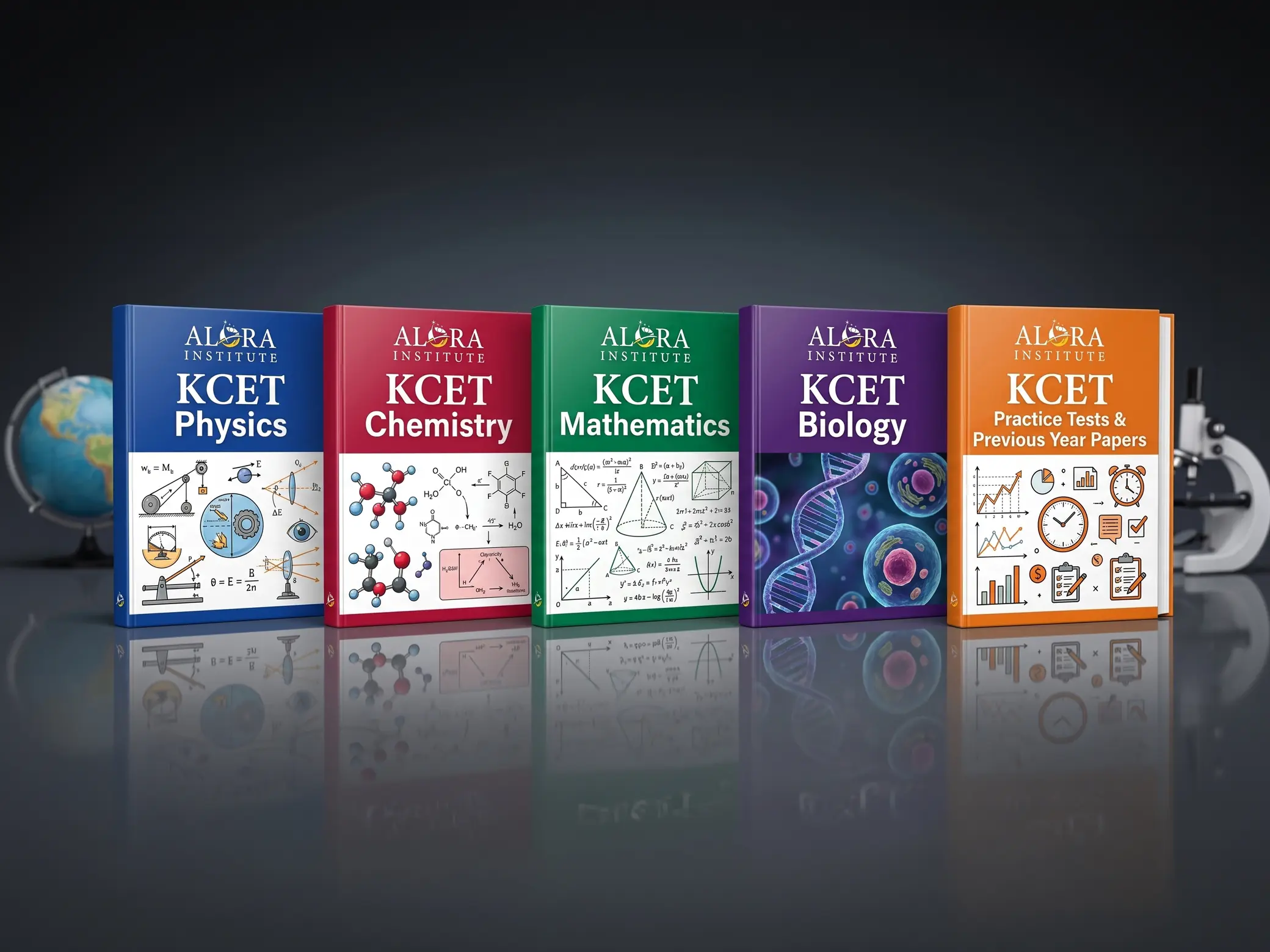
KCET (Karnataka Common Entrance Test) is a state-level entrance examination conducted in Karnataka, India. It is administered by the Karnataka Examinations Authority (KEA) and is primarily aimed at facilitating admissions to undergraduate courses in various fields, such as Engineering, Architecture, Pharmacy, and other professional courses offered by colleges and institutions in Karnataka.
What will you learn and How?
Mathematics :
Mathematics is a fundamental subject in KCET courses, especially for engineering and technical fields. It covers topics such as algebra, calculus, trigonometry, geometry, probability, and statistics.
Physics :
Physics is another core subject in KCET courses. It focuses on the study of matter, energy, motion, and the principles governing the physical world. Topics covered may include mechanics, thermodynamics, optics, electromagnetism, and modern physics.
Chemistry :
Chemistry plays a crucial role in understanding the properties, composition, and reactions of substances. Topics covered in KCET chemistry courses include inorganic chemistry, organic chemistry, physical chemistry, and environmental chemistry.
Biology :
For courses related to pharmacy, veterinary science, or alternative medicine, biology is an important subject. It covers topics such as cell biology, genetics, physiology, plant biology, human anatomy, and microbiology
Classroom Lectures :
Students attend regular lectures delivered by professors and subject matter experts. These lectures cover the theoretical aspects of the subjects included in the KCET syllabus. Professors may provide explanations, examples, and insights to help students understand the concepts.
Study Resources and Assignments :
Institute provides study materials, textbooks and students are assigned various assignments,problem-solving exercises related to the subjects they are studying. These assignments help students apply their knowledge, develop critical thinking skills, and deepen their understanding of the topics.
Test Preparation and Practice :
In preparation for the KCET examination, we provide test preparation sessions, practice exams, and mock tests to familiarize students with the exam format, assess their understanding, and improve their test-taking skills.
Motivation and Emotional Support :
To keep students enthusiastic we often provide motivational sessions and emotional support to help students stay focused, motivated, and confident during their preparation journey.
Personalized Guidance :
Alora offers personalized guidance to students, including individual counseling sessions, performance analysis, and guidance on exam strategy. This helps students identify their strengths and weaknesses, set goals, and work on areas that require improvement.
Discover your potential.
Build your future with Alora Institute.
We recognize that every student’s journey is unique. Through a blend of highly experienced faculty, innovative study materials, and a deeply personalized approach to mentorship, Alora Institute provides an ecosystem where students are supported, challenged, and inspired to achieve their ultimate academic goals.

State CET Examination & Preparation FAQs
General Exam Information
State Common Entrance Tests (CETs) are conducted by state governments for admission to various undergraduate courses in Engineering, Agriculture, Pharmacy, and allied health sciences strictly within that specific state’s government and private colleges.
CET exams are generally considered slightly easier than JEE Main and NEET. They focus heavily on the state board syllabus and emphasize speed and accuracy over complex, multiconcept problem-solving. Furthermore, JEE/NEET are national-level exams, whereas CET mostly caters to state domicile candidates.
This varies by state. For instance, KCET (Karnataka) generally does not have negative marking, which encourages students to attempt all questions. MHT-CET (Maharashtra) also does not have negative marking. However, always check the official brochure of your specific state’s CET for the current year’s rules.
KCET is an offline (pen-and-paper) exam consisting entirely of Multiple Choice Questions (MCQs). The pattern is as follows:
- Subjects: Physics, Chemistry, and Mathematics (for Engineering/Architecture) or Biology (for Medical / Agriculture/ Pharmacy).
- Questions & Marks: Each subject paper has 60 questions carrying 60 marks (1 mark per correct answer).
- Duration: Students are given 80 minutes to complete each subject paper
- Negative Marking: There is no negative marking for incorrect answers.
Preparation Strategy
Yes, the state CETs are primarily based on the respective state board syllabus for Class 11 and 12. Thoroughly reading the state board textbooks and solving all the back-exercises is the most crucial step for CET preparation.
Since CET exams often require you to solve many questions in a limited amount of time (e.g., 60 questions in 80 minutes), speed is critical. You can improve this by memorizing formulas, learning calculation shortcuts, and taking time-bound mock tests regularly to train your mind to react quickly to straightforward questions.